Info zone
Why insulate?
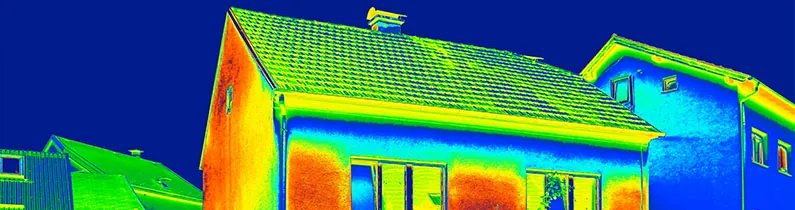
Good thermal insulation "from basement to roof" always pays off! Here are six reasons — reasons that apply in Serbia today. At the end we add a seventh, which is not yet a reality in Serbia but very much is in the EU, where it is even the most "tempting" reason for people to insulate the buildings they live and work in.
1. Lower energy costs
More than 70% of the heat of your home (or office) is lost through the walls, the roof and the basement. With Austrotherm insulation you will save a lot on your energy bills every year — and remember that it is not only heating (in winter) that costs money but also cooling (in summer): air conditioners use even more energy than radiators! Looking at the payback of buying and installing insulation over the long term against the savings you achieve, you will conclude for yourself that insulation really pays. Mathematics, fortunately, is a very exact science.
2. Comfort at home and at work
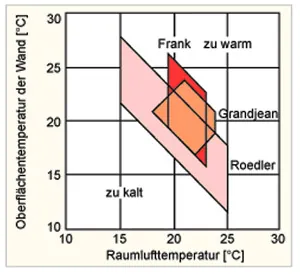
The ideal indoor climate for living and working is a temperature between 19 °C and 22 °C and a relative humidity between 40% and 60%.
Achieving this needs well-insulated walls, where the temperature difference between the inner surface of the wall and the room is no more than 3 °C (in winter and in summer). With these ideal temperature differences you ensure comfort in your home.
A well-insulated home with targeted ventilation creates a climate in which the risk of mould — which is of course harmful to health — is reduced to a minimum.
3. Protecting the environment
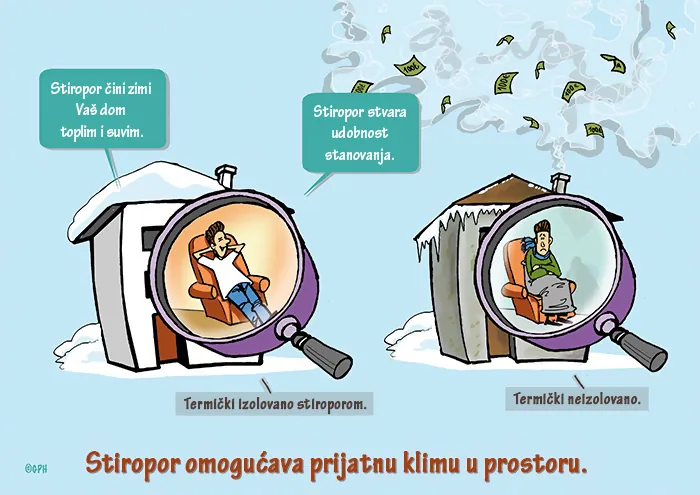
By using our insulation materials, and so reducing the need for heating, you actively help protect the environment by cutting carbon dioxide (CO2) emissions — heating is responsible for about one third of all CO2 emissions. Global warming is ever more noticeable, and global temperatures are expected to rise further, and with them the greenhouse effect: an increase of up to 3.5 °C is expected by 2100, with devastating effects on ecosystems and on life on earth.
- Read more
4. Keeping and raising the value of the building
Having "your own four walls" is one of the most important goals in life. Owning property, especially in unstable economic times, is a valuable asset and a great security. The better your property (house, flat, office building) is insulated, the higher its market value. With energy prices constantly rising in the 21st century (understandably, as energy resources run out), thermal refurbishment is very much in demand: insulating previously uninsulated buildings (walls, slabs, roof) raises their value. Last but not least, EU countries already require an "energy passport" for buildings, which gives each building its energy class — much like household appliances. A good energy passport automatically means a higher overall quality, and so a higher market value, of the building.
5. Independence (or less dependence) from insecure energy sources
The great gas crisis between Russia and Ukraine in 2009 showed how dangerous it is to depend on unstable and insecure energy sources. At its peak, all of Europe waited anxiously to see whether and how the crisis would be resolved. Does anyone really believe it was the last crisis of its kind? Or that the many wars in the Middle East had nothing to do with energy and that there will be no such wars in future? Well-insulated buildings reduce dependence on energy, and so on energy sources of whatever kind — which matters most when those sources are unstable and insecure.
6. Energy is used in summer too — cooling costs even more than heating!
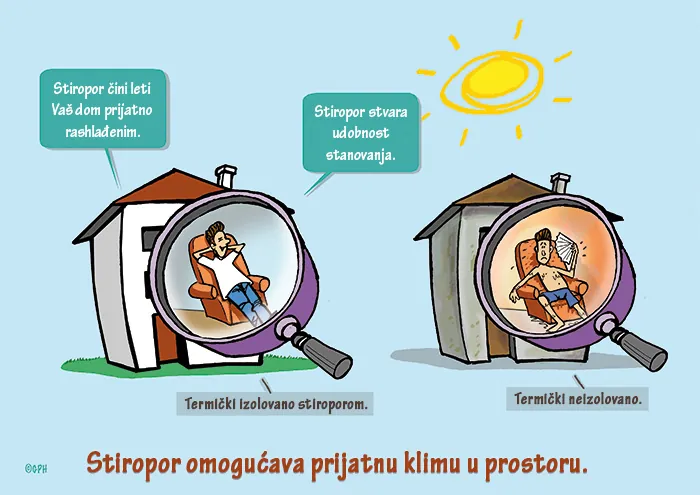
Climate change is perhaps most obvious in summer temperatures, especially in south-eastern Europe and so in Serbia. Were summer temperatures of 40 °C and more usual in Serbia 20 or 30 years ago? And if such tropical temperatures did occur, did they last for weeks on end as they do today? Is an air conditioner still the luxury it was in the 1970s or 1980s, or has it become a necessity for getting through the summer heat? Remember: good insulation stops the summer heat from getting into the house (flat, office) as it does into an uninsulated building. That means less need for air conditioning, lower energy use and a fuller wallet for whoever pays for the energy.
7. Benefit from state subsidies
Unfortunately this is not yet possible for residents of Serbia (or neighbouring countries), but it has been possible for some time in Austria, Germany and other EU countries. There, and elsewhere (e.g. Switzerland), regulations set a minimum level of insulation for buildings. If you insulate your building better than the required minimum, in a new build or a refurbishment, the state rewards you, e.g. by partly financing the construction of low-energy or even passive houses. More on this in the related articles of our Info zone.
Ask Austrotherm
Questions about our products and services
Answers come only from the content of this website, with links to the pages. For project decisions talk to your designer or our technical support.
The assistant needs JavaScript. Ask our technical support: Contact