Info zone
A plus or a minus for the environment?

"They are not environmentally sound, their raw materials or production are questionable" — these are the most common prejudices about polystyrene insulation. Against them stand massive savings of fossil fuels (energy) and of harmful emissions. So what is the verdict — a plus or a minus for the environment? To answer this, we took a detailed look at this popular insulation.
Some users of polystyrene insulation have become unsure, confused by press reports that cast a material made from fossil fuels in a bad light — completely without justification, as it turns out. It is true that expanded (EPS) and extruded (XPS) polystyrene are made from oil, a non-renewable energy source, but the indisputable positive properties of this insulation for sustainability and the environment are overlooked.
Even building life-cycle assessments today grant polystyrene its ecological credentials. Overall, the environmental advantages prevail — high energy savings and a strong reduction of CO2 and of other harmful emissions through polystyrene insulation. And looking at each aspect of the use of EPS and XPS separately, the sustainability test turns out positive.
When is an insulation material environmentally friendly?
Which factors determine the environmental profile of a building material? Such an assessment examines, first, the resources and energy needed for production; second, the energy saved during use, especially the reduction of CO2 and other harmful emissions; and third, the options for recycling the material and recovering energy from it.
2% oil, 98% air
Crude oil comes first. Expanded polystyrene (EPS) is an oil derivative, but it needs only a very small share of this valuable resource: EPS consists of as much as 98% "pure" air! Relative to the finished product, the raw material used — only 2% of the volume — is extremely low.
And another telling figure: only 0.1% — one thousandth — of world oil consumption is used to make EPS. By comparison, about 60% of world oil consumption goes into transport. Making EPS is also a very intelligent use of a raw material: it makes far more sense to invest crude oil in insulation than to burn it for heating. Moreover, the EPS made today can be reused after its life as insulation — whereas oil that is burnt has left the material cycle for ever!
So the claim that oil is wasted in making EPS boards is simply untrue — quite the opposite: here oil is used very wisely. Using oil for insulation pays back very quickly, because far more oil (or its equivalent) is saved this way.
Superior in production and transport
Insulation materials from renewable resources have an advantage in resource use. In production energy, however, the picture is less clear. Comparing the energy needed to make different insulation materials, polystyrene comes out ahead: making 1 m² of grey graphite EPS takes close to 40 MJ, while wood-fibre insulation, for example, takes as much as 310 MJ. For comparison, 3.6 MJ equals 1 kWh of electricity or heat — enough to run a laptop for 50 hours or a 12 W energy-saving bulb for 83 hours.
In transport energy, too, the facts favour polystyrene. EPS, for instance, is foamed on site in the plant — with 98% air in it — so only a small share of the raw material is transported. Other raw materials are delivered to the plant in the full volume of the later product.
Heating savings
The decisive factor lies in the purpose of insulation itself: in use, all insulation materials save many times more energy than is needed to make them.
The importance of this becomes clear when you know that heating buildings accounts for 32% of the energy demand of most industrial countries — in the developed world most energy goes into heating. Polystyrene insulation can reduce this demand considerably: every litre of crude oil used to make polystyrene insulation saves about 100 litres of refined oil that would otherwise be burnt for heating. An impressive balance.
"When it comes to the ecological value of insulation, one thing matters a great deal," stresses Franz Roland Jany of the Austrian association of insulation manufacturers (GDI): "correct, professional installation. Mistakes that create thermal bridges or poor connections to windows can considerably reduce the energy saving and so cancel out the ecological goal."
The energy pays back quickly
"Grey energy" is the energy needed to make, transport, store and recycle a product. Adding up these values and comparing them with the heating energy saved shows when an insulation has paid back in ecological terms.
Here too the result for polystyrene is outstanding: within less than a year of use, the energy and emissions of its production are offset by the energy it saves. A house built in the 1970s illustrates it: after refurbishment, all the energy used to make the insulation was "returned" within two to four months of living in the insulated house. "There is no measure in the energy sector with a better balance than investing energy in insulation," says Benjamin Krick of the German Passivhaus Institut (which focuses on promoting passive buildings).
Durable and stable for the long term
A long service life is very important. Once installed, insulation lasts practically as long as the building. Its insulating values do not weaken over time; for polystyrene there are studies showing that its technical properties had not deteriorated after many years. The same applies to the dimensional stability of properly installed insulation.
Effectively avoiding CO2 emissions
A major event took place in 2011, from 30 November to 11 December: a UN climate conference continuing the 1997 Kyoto Protocol, with a new, improved climate agreement. The main goal was and remains to counter the greenhouse effect.
Everything heating systems emit ends up directly in the atmosphere and joins the mass of gases high above us that affects our global climate. The greenhouse effect has many consequences: mega-storms, catastrophic forest fires, spreading deserts and other extreme weather. All of these directly affect the world economy — agriculture, transport and energy supply. Carbon dioxide (CO2) plays the most important role in this destructive mechanism, accounting for more than half of the greenhouse effect.
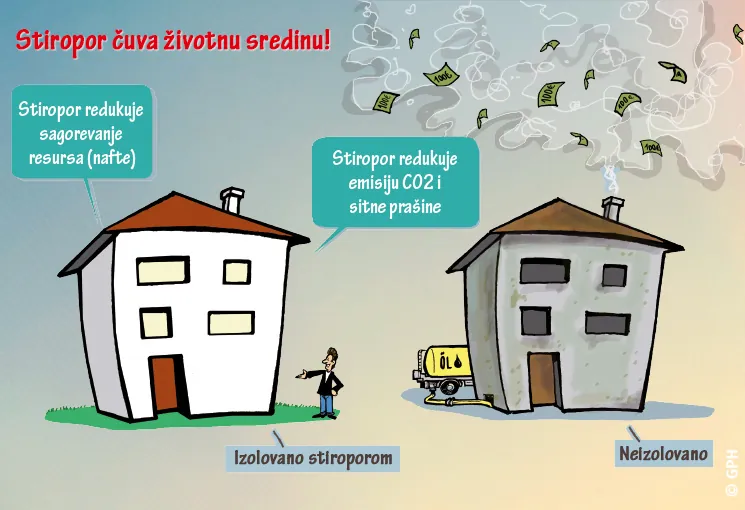
Insulation reduces CO2 emissions, simply because well-insulated buildings burn less fuel than poorly insulated or uninsulated ones. And remember: insulation saves up to 200 times more energy than is needed to make it!
Production energy needed for different insulation materials
Grey (graphite) EPS: 39.84 MJ

White EPS: 39.84 MJ
Mineral foam: 72.32 MJ

Stone wool: 78.00 MJ
Hemp fibre: 115.15 MJ
Bricks filled with mineral wool: 179.06 MJ

Wood fibre: 310.06
The switch to pFR
An important factor in the environmental balance of a substance is whether it can be recycled. Until now this was considerably limited by the HBCD-based flame retardant used in EPS and XPS insulation until 2014.
With the new pFR-based additive, the result of many years of research and development, a suitable replacement for HBCD has been found. Thanks to its polymer structure this alternative additive is not "bioavailable": it does not accumulate in plants or animals and is not toxic — a sustainable solution.
Energy recovery
XPS and EPS can be incinerated without problems, as the process leaves no harmful or hazardous residues. The flue gases correspond to those of burning wood, and the ash is biodegradable. Old boards containing HBCD are destroyed without residue in thermal recycling, i.e. removed from the environmental cycle.
A trial at a waste incineration plant in Würzburg, Germany, showed that burning EPS insulation boards has no negative environmental effects whatsoever. The energy contained in the boards is very useful: recycled by incineration in modern plants, they produce the same energy as burning oil directly.
Strong arguments
As we have seen, polystyrene used as insulation is fundamentally good for the environment — it saves the planet's resources, is made with little energy, saves heating energy and harmful CO2 emissions, and, thanks to the new additive, can be recycled in a continuous material cycle without difficulty. Conclusion: no other man-made material on Earth proves as positive for the environment as polystyrene!
Ask Austrotherm
Questions about our products and services
Answers come only from the content of this website, with links to the pages. For project decisions talk to your designer or our technical support.
The assistant needs JavaScript. Ask our technical support: Contact