Pitched roof
Insulation above the rafters
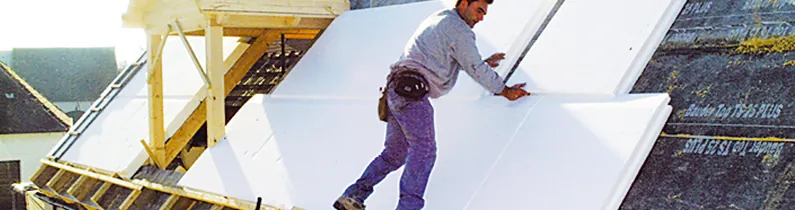
Insulating a pitched roof from the outside is common in Western Europe. Its advantage over insulating from the inside (between the rafters) is that air cannot pass through the ventilated layer (between the tiles and the roof structure) and appear between the rafters, so heat losses in winter are avoided and the insulation is more effective. The rafters are boarded from the outside, then the waterproofing is laid (e.g. a vapour-permeable bitumen membrane) and then the insulation, for which we recommend Austrotherm EPS A150, our hardest EPS board. It is needed because above the rafters the boards carry high loads (including compressive loads) from direct exposure to the weather (wind, rain, snow etc.). We recommend the following thicknesses of Austrotherm EPS A150, which give the U-values shown in the table:
| recommended thicknesses of Austrotherm EPS® A150 above the rafters | U-values [W/m²K] |
|---|---|
| 120 mm | 0.25 |
| 140 mm | 0.22 |
| 160 mm | 0.19 |
| 180 mm | 0.17 |
| 200 mm | 0.16 |
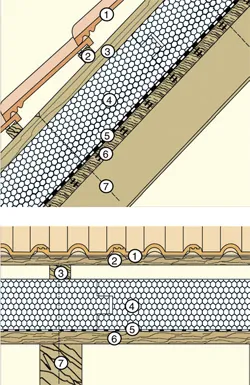
- 1roof tiles
- 2battens (cross battens)
- 3battens (counter battens)
- 4Austrotherm EPS A150
- 5waterproofing layer
- 6full board sheathing
- 7rafters
After laying the Austrotherm EPS A150 boards over the rafters, first fix the counter battens (in the direction of the rafters) and then the cross battens that carry the tiles. The two layers of battens create an air space that serves as additional insulation (air circulation, roof ventilation). The first counter batten is nailed or screwed through the EPS into the rafter; at the eaves a starter batten is fixed first, on which the first row of EPS boards rests — it also stops the boards from sliding off.
This way of insulating the roof has another advantage: the load-bearing roof structure remains visible after insulation (provided the work is done professionally, also with regard to fire protection). Make sure the waterproofing (usually bitumen sheets) is laid so that it seals well against wind. If you lay, for example, a 40 mm visible timber boarding under the waterproofing, you also get excellent sound insulation: a sound insulation value of 49 dB is quoted for this construction.
If the rafters (visible from inside with this type of roof insulation) are closed from the inside with plasterboard or similar materials, and the fields between the rafters as well, at least fire resistance class F30 must be ensured, i.e. at least 30 minutes of fire resistance.
Recommended products
Insulation advisor
Describe the job — get the right boards
Tell us what you are insulating and with what. The advisor picks from Austrotherm products only and quotes our own data; the site then works out the packs.
- Describe the building element and the situation
- Get the element, the boards and the open questions
- Calculate packs and the indicative thickness
Indicative calculation
How many packs?
Packs from our own packing lists: area ÷ m² per pack, rounded up. With a target U-value the calculator shows the indicative insulation thickness d = λ × R.
Enter the area to see the number of packs.
Indicative only — the final choice and thickness are confirmed by your designer or Austrotherm technical support. The thickness estimate takes the insulation layer alone (R = 1/U) and does not check any regulation.
The assistant needs JavaScript. Ask our technical support: Technical support · +381 (0)11 23 69 283 · All products
Private customers and contractors
We sell wholesale only. Our products are on sale at hundreds of building-material dealers in Serbia and Montenegro.
Building-material dealers
Registered companies order directly from us — with the order form and the current price list.