Flat roof
Inverted roof
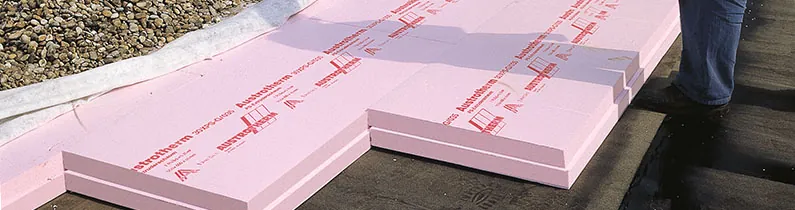
An "inverted roof" is a flat roof whose defining feature, unlike the usual flat roof, is that the insulation lies above the waterproofing. Such a roof only became possible with insulation materials that practically do not absorb water. It is characterised by three factors:
Safety
The durability of a flat roof depends on how well the individual functions of the construction work together.
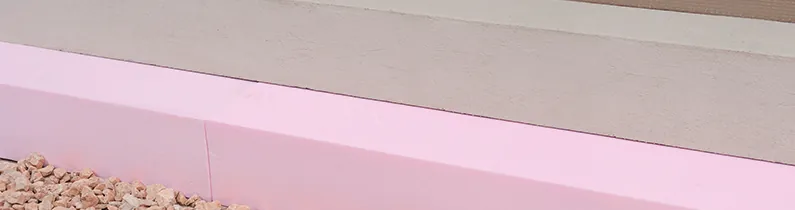
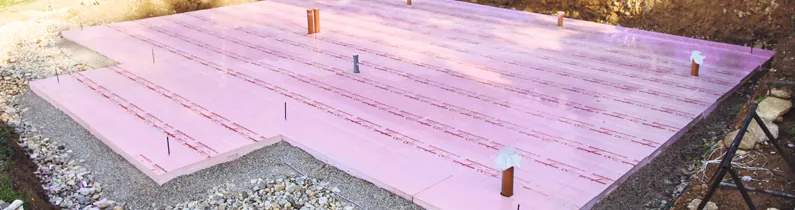
The load-bearing structure is protected from the weather, above all from moisture and water, by good, durable waterproofing. This works best when the waterproofing itself is protected from extreme heat (in summer) and severe frost (in winter). Our pink Austrotherm XPS (extruded polystyrene insulation board) protects the waterproofing of a flat roof in exactly this way.
It follows that our pink Austrotherm XPS is used on building sites all over Europe to protect the waterproofing of flat roofs. Our XPS boards relieve the waterproofing of large thermal stresses.
Our XPS boards also protect the waterproofing from damage during normal work on site, when people may damage it unintentionally (or carelessly).
Inverted flat roofs have proved themselves in practice for years and belong to the "recognised rules of technology" (German: "Anerkannte Regel der Technik"), a phrase you will find across the German-speaking countries of Europe (Germany, Austria, Switzerland, Luxembourg). Any building method it applies to is considered sound, correct and indisputable.
Simplicity
A clear separation of structure, waterproofing and insulation — 3 layers with 3 clear functions. No vapour barrier or vapour-pressure equalisation layer is needed below the waterproofing.
Economy
Good experience with the durability of inverted roofs and their simple build-up speak for the economy of these roofs, of which Austrotherm XPS is an essential part.
Outstanding insulation values — the thermal conductivity of our pink Austrotherm XPS is only 0.035 [W/mK] for thicknesses up to 60 mm, 0.036 [W/mK] up to 120 mm and 0.038 [W/mK] up to 200 mm — mean that thinner XPS achieves the same effect as some other insulation materials in greater thickness. Good insulation, of course, raises the energy efficiency of the building, lowers the cost of energy and at the same time makes every energy user part of active environmental protection. In today's industrial age our environment is anything but well protected; awareness of this should matter to everyone as much as saving their own money.
Variants
Duo roof ("plus roof")
The duo roof is a special form of flat roof that combines a conventional warm roof and an inverted roof: Austrotherm EPS® insulation lies below the waterproofing and Austrotherm XPS® above it (protecting the waterproofing from mechanical damage and high temperatures).
The "intelligent" duo roof is particularly suited to older roofs that may still be watertight but whose insulation no longer meets today's requirements. It is a simple and effective way to insulate a roof during thermal refurbishment.
The duo roof offers the greatest safety, because the waterproofing lies below the Austrotherm XPS® boards. As a result, a duo roof lasts twice as long without refurbishment as a conventional warm roof — which gives it an excellent price-performance ratio.
Below the waterproofing there is a warm roof (with Austrotherm EPS® insulation), which can be built with or without a fall.
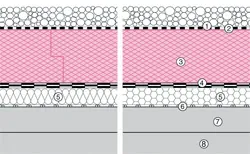
- 1drainage layer (gravel 16/32)
- 2geotextile
- 3Austrotherm XPS® TOP 30
- 4existing waterproofing
- 5Austrotherm EPS® A120 or Austrotherm EPS® A150
- 6vapour barrier and vapour-pressure equalisation layer
- 7fall layer
- 8reinforced concrete slab
Recommended products:
Gravel-ballasted inverted roof
The simplest form of inverted flat roof is the gravel-ballasted roof. Gravel as the top layer does not prevent walking on the roof but makes it harder. Our Austrotherm XPS TOP 30 (shown in the sketch below with stepped edges) is, we repeat, frost-resistant and very moisture-tight — it does not absorb water!
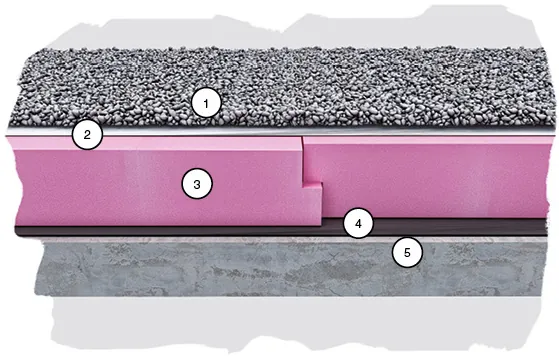
- 1gravel (16/32)
- 2filter / protective layer
- 3Austrotherm XPS TOP 30
- 4waterproofing
- 5reinforced concrete slab
Recommended product:
Rooftop car park
An inverted roof that takes heavier mechanical (compressive) loads is the logical choice for surfaces used by vehicles and machines — for example the flat roofs of public garages, which often serve as car parks too.
For this we recommend our extruded polystyrene boards; you can choose between Austrotherm XPS® TOP 30, Austrotherm XPS® TOP 50 and Austrotherm XPS® TOP 70. For optimal thermal insulation a board thickness of at least 200 mm is recommended. After the insulation and a gravel layer, the top layer is laid — precast reinforced concrete slabs, a cast reinforced concrete slab or paving slabs.
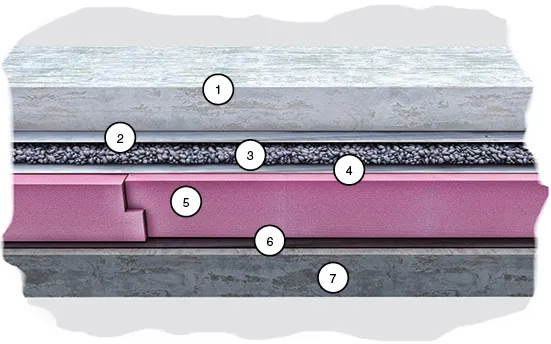
- 1top layer (e.g. reinforced concrete)
- 2geotextile
- 3drainage layer (gravel from 2/8 to 16/32)
- 4Austrotherm XPS TOP 30 / 50 / 70
- 5waterproofing (e.g. bitumen)
- 6fall layer
- 7reinforced concrete slab
Recommended product:
Roof terrace
A roof terrace is not only found on the top of a building — you can have one above a garage, above soil and so on. In every case it is a form of inverted roof (in its insulation and the order of the layers) with terrace slabs as the top layer. They can rest on pedestals (which may even be pieces of our Austrotherm XPS) or on a layer of gravel. Any type of terrace slab can be laid on this build-up, even the heaviest. Our Austrotherm XPS TOP 30 takes a compressive load of as much as 11 t/m² (at 5% deformation, the upper limit used to rate a material's compressive load capacity).
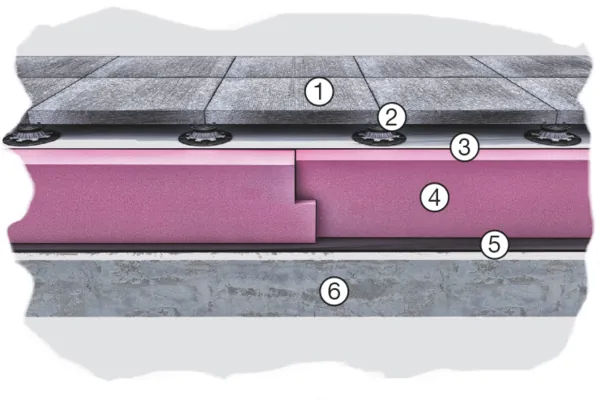
Resting on pedestals
- 1terrace slabs
- 2pedestal, Austrotherm XPS TOP 30
- 3geotextile
- 4Austrotherm XPS TOP 30
- 5protective layer (foil)
- 6reinforced concrete slab
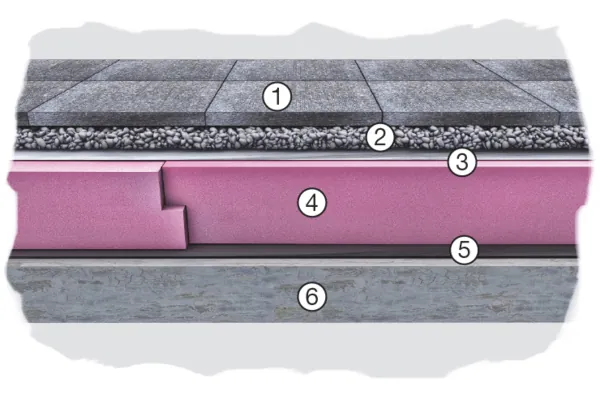
Resting on a gravel layer
- 1terrace slabs
- 2cushioning drainage layer (gravel 2/8)
- 3geotextile
- 4Austrotherm XPS TOP 30
- 5protective layer (foil)
- 6reinforced concrete slab
Recommended product:
Green roof
Green roofs are in! They reflect our need for, and longing for, natural surroundings — something people living and working in big cities miss. It is no exaggeration to call it a quality of life everyone cares about. Not only in dense urban residential areas but also in public and industrial building, green roofs can create living space for plants.
Plants, as we know, produce oxygen, regulate humidity, clean the air around us and so create a better microclimate. Green roofs have a high ecological value. Modern flat-roof constructions such as the inverted roof with our XPS insulation are a safe basis for achieving it. For people and their health, they bring a physical and psychological improvement in the quality of life.
Inverted roof with extensive greening. Extensive greening means vegetation that maintains and develops itself and changes its appearance over time. It is neither watered nor mown, and it is also suitable for structural reasons. Areas with extensive greening are generally not walked on and are not considered walkable, except for maintenance.
Inverted roof with intensive greening. Intensive greening includes lawns and various plantings. In its many uses and design options it is similar to other open spaces on natural ground. The plants must be watered and generally tended. A drainage layer, e.g. of gravel, is essential here. Walking on intensive greening is in principle possible and realistic in practice.
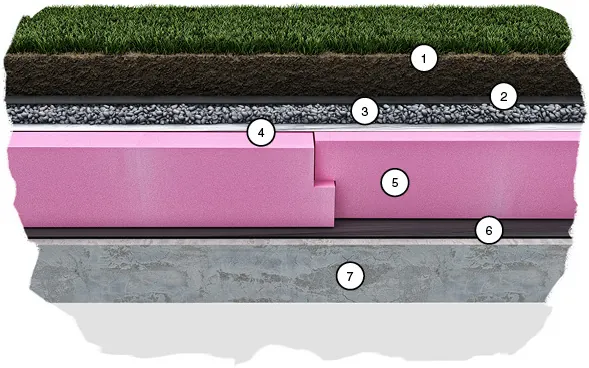
- 1vegetation layer
- 2geotextile
- 3drainage layer (gravel from 2/8 to 16/32)
- 4protective foil
- 5Austrotherm XPS TOP 30
- 6waterproofing (root-resistant)
- 7reinforced concrete slab
Recommended product:
Recommended products
 XPS TOP
Austrotherm XPS TOP 30
Thermal insulation board of extruded polystyrene with a smooth surface
- Compressive strength
- 300 kPa
- Permitted load (2%)
- 130 kPa
- Fire class
- E
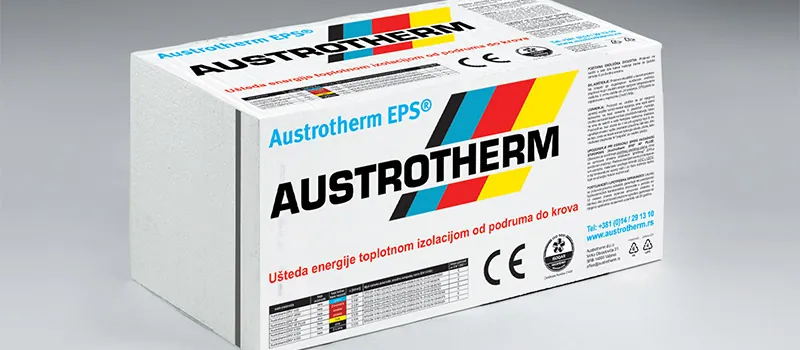 EPS / EPS PLUS
Austrotherm EPS A120
Thermal insulation board of expanded polystyrene (EPS)
- λ
- 0.034 W/mK
- Compressive strength
- 120 kPa
- Permitted load (2%)
- 30 kPa
- Fire class
- E
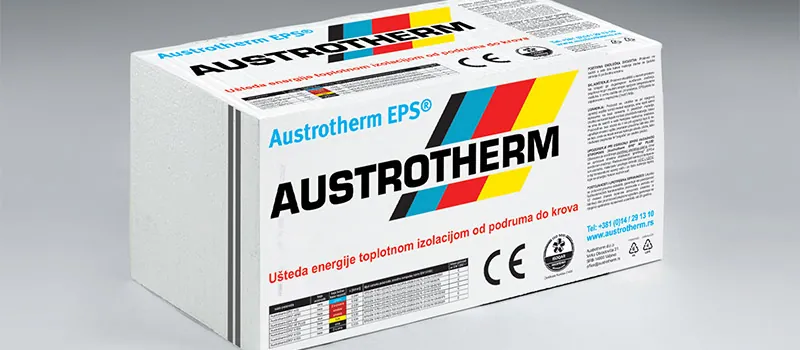 EPS / EPS PLUS
Austrotherm EPS A150
Thermal insulation board of expanded polystyrene (EPS)
- λ
- 0.033 W/mK
- Compressive strength
- 150 kPa
- Permitted load (2%)
- 40 kPa
- Fire class
- E
 XPS TOP
Austrotherm XPS TOP 50
Thermal insulation board of extruded polystyrene with a smooth surface
- Compressive strength
- 500 kPa
- Permitted load (2%)
- 180 kPa
- Fire class
- E
 XPS TOP
Austrotherm XPS TOP 70
Thermal insulation board of extruded polystyrene with a smooth surface.
- Compressive strength
- 700 kPa
- Permitted load (2%)
- 250 kPa
- Fire class
- E
Insulation advisor
Describe the job — get the right boards
Tell us what you are insulating and with what. The advisor picks from Austrotherm products only and quotes our own data; the site then works out the packs.
- Describe the building element and the situation
- Get the element, the boards and the open questions
- Calculate packs and the indicative thickness
Indicative calculation
How many packs?
Packs from our own packing lists: area ÷ m² per pack, rounded up. With a target U-value the calculator shows the indicative insulation thickness d = λ × R.
Enter the area to see the number of packs.
Indicative only — the final choice and thickness are confirmed by your designer or Austrotherm technical support. The thickness estimate takes the insulation layer alone (R = 1/U) and does not check any regulation.
The assistant needs JavaScript. Ask our technical support: Technical support · +381 (0)11 23 69 283 · All products
Private customers and contractors
We sell wholesale only. Our products are on sale at hundreds of building-material dealers in Serbia and Montenegro.
Building-material dealers
Registered companies order directly from us — with the order form and the current price list.